Be aware of “the thinker”. Watch “the thinker”. Listen to his voice impartially, do not judge. By doing this you activate a higher-level of consciousness.
– Eckhart Tolle
I decided to use the dice to pick my colours because then I would have less influence on things.
Luckily I found a watercolour set that had 12 colours so I could use two dices to decide. (the first colour was white so it didn’t matter that number 1 couldn’t be chosen, especially using white paper)
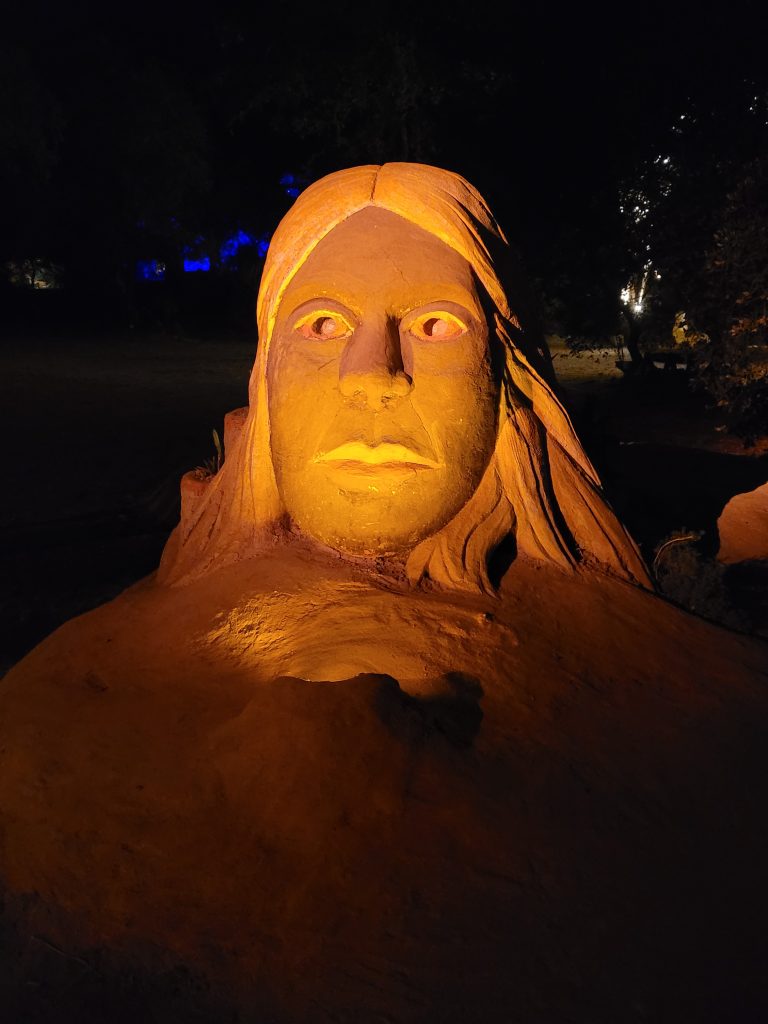
Anyway the dice chose 6 and 8 (blue and orange) which is not a bad choice really. I wasn’t sure what I was going to paint in orange and blue (the sunset was too cliche) so I looked at a few old photos of ours that might be adaptable to different hue. One that stood out however was from our recent visit to the Boom festival in Portugal. It was of one of the statues they lit up at night and was already so orange and dark bluey that I thought I could copy it quite easily. Obviously for me, copying would be preferable to attempting anything from my head so the picture was chosen.
Watercolour may not have been the best option because I usually struggle with the medium but I didn’t want to spend too long on the project. I’d budgeted for a couple of hours at most and so oils and acrylics were not going to work for me
I found a slightly yellow A4 paper that was thicker than most of the white paper I had so I thought this would help with wtercoour. The painting was harder than I thought. The restriction of two colours meant that I struggled to get any detail on the paper using orange/watery orange/ orange with a tinge of blue/ orange with more blue etc. Lots of it inevitably became a sort of brown. Then running through the browny to blue ranges – how do I get any darker than blue than the blue I’ve already got or any lighter than the orange?
So I had to incorporate a bit of black and white mixing to help me here. It did give the picture a bit more of a chance to succeed but the layers of watery paint on watery paint struggled on the paper I was using. I tried for over an hour but I kept painting and repainting bits until the figure I was painting became a ghastly watery thing. Nothing like the original photo but that was OK, it was art!
The end result was a bit disappointing from a great artists aspirational point of view, but for me I think it had genuinely produced something unique. And anyway, the point of the exercise was not to be so goal-orientated or results driven. It was doing art for the joy of being in the moment enjoying the exercise and that’s what I did.
Was I aware of “the thinker”, and listening to my inner voice? Probably not as much as I should have been. My inner critic was shouting at me too much, and it drowned-out those brief cosmic moments when I could just apply paint without thought.
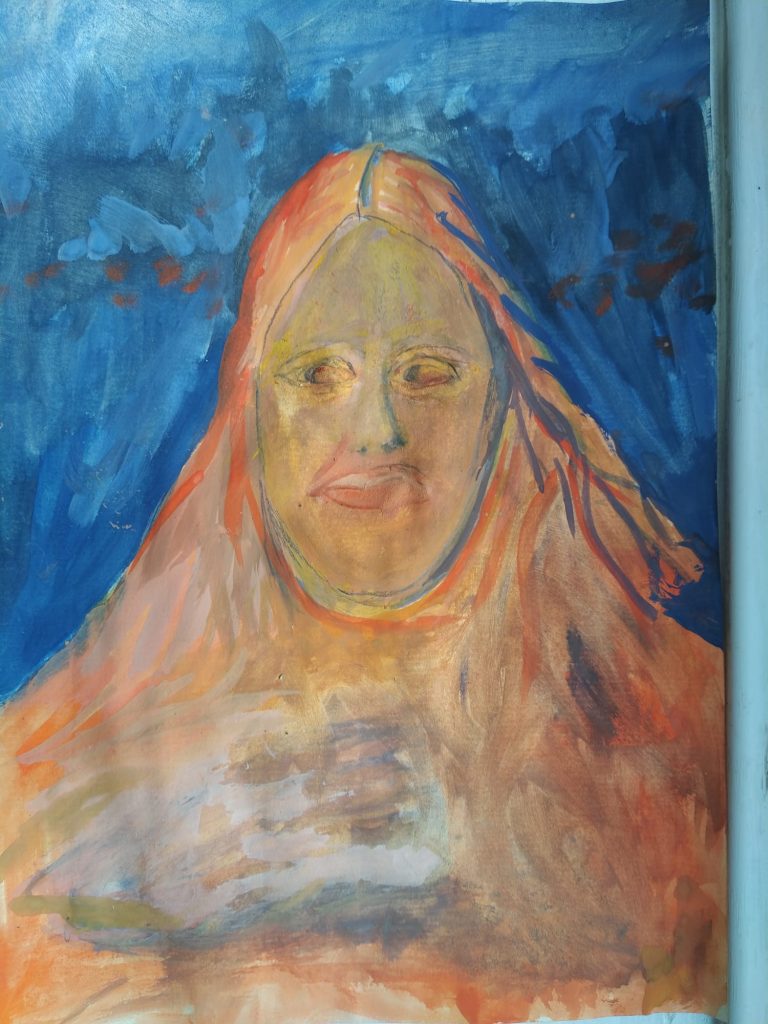
So this is the result of those 3 hours of my life. A haunting depiction of a figure trying to emerge from the paper to teach me that activating my higher consciousness is gonna need more time.
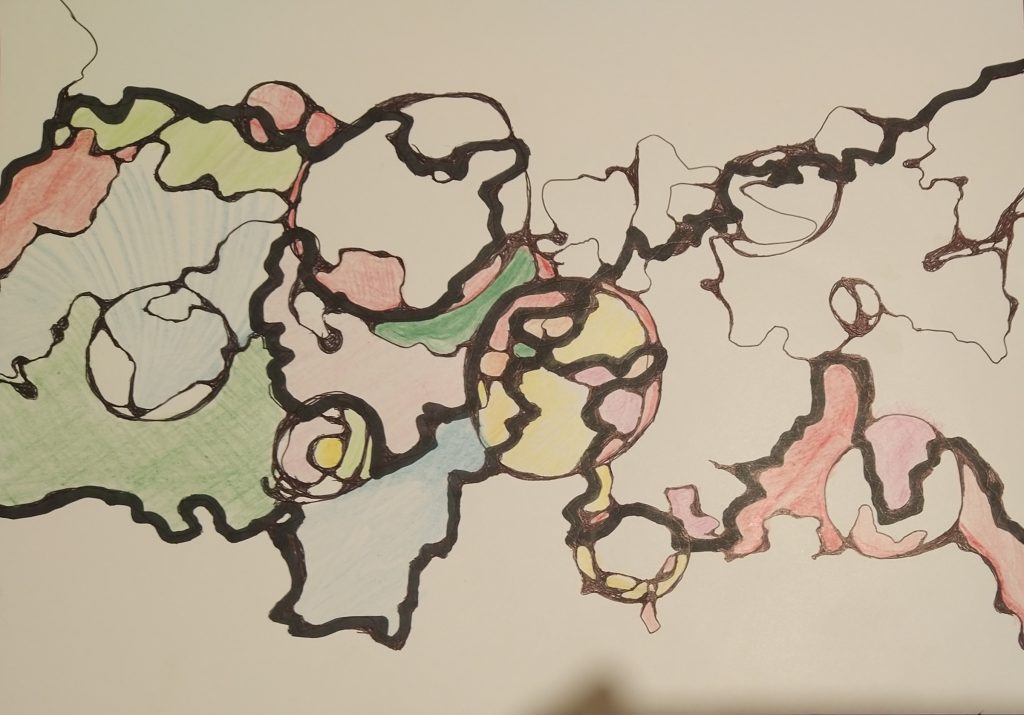
Incidentally, I did manage to silent my inner critic while doing some neurographic art the other day. This form of abstract art requires no thinking, and follows a few simple rules enabling you to produce fascinating patterns on paper with little more than a pen, and a few coloured pencils. I won’t bore you with the neurographical details because google can do that for you. But I found peace and satisfaction lost in a few hours of scribbling on paper, and my consciousness was completely unaware of what I producing.
Be aware of “the scribbler”. Watch “the scribbler”. Listen to his voice impartially, do not doodle. By doing this you activate a higher-level of artlessness.
